


In March 2024, Formula 1 driver Carlos Sainz underwent surgery for appendicitis, forcing him to miss the Saudi Arabian Grand Prix.
Just two weeks later, he returned to racing in Australia – and won the Grand Prix.
Sainz subsequently spoke about the intensive rehabilitation programme he followed to prepare for his return to Formula 1. Among the treatments he mentioned was INDIBA.
So what is INDIBA, why is it used in sports rehabilitation, and could it have applications beyond elite sport?
What is INDIBA therapy?
INDIBA is a non-invasive radiofrequency therapy used in physiotherapy, rehabilitation and sports medicine.
It uses radiofrequency energy at a specific frequency of 448 kHz, delivered through electrodes applied to the body.
The technology is designed to produce biological and thermal effects within the tissues, depending on the treatment settings being used.
Research has investigated its potential effects on pain, tissue recovery, circulation and musculoskeletal function.
Carlos Sainz and INDIBA
Sainz’s recovery attracted considerable attention because of the physical demands involved in returning to a Formula 1 car so soon after abdominal surgery.
Speaking about his recovery programme, he explained that he had used a combination of approaches, including hyperbaric oxygen therapy and INDIBA.
His recovery shouldn’t be interpreted as proof that INDIBA was responsible for his rapid return to racing.
Elite athletes have access to intensive medical and rehabilitation support, and Sainz himself described using several different approaches.
However, his experience provides an interesting example of how INDIBA technology is incorporated into modern sports rehabilitation.
Why is INDIBA used in sports rehabilitation?
For an elite athlete, returning to training and competition following injury is about more than simply reducing pain.
Rehabilitation may involve restoring:
- Movement
- Muscle function
- Strength
- Confidence
- Sport-specific performance
INDIBA can be incorporated alongside hands-on treatment, exercise and rehabilitation where appropriate.
It is used within professional sport as well as in clinics treating everyday musculoskeletal problems.
What conditions might INDIBA be used for?
INDIBA has been investigated and used in the management of a range of musculoskeletal problems.
These include some forms of:
- Muscle and soft-tissue injury
- Tendon problems
- Joint pain
- Osteoarthritis
- Back pain
- Neck pain
- Sports injuries
Whether INDIBA is appropriate depends on the individual problem and assessment.
It shouldn’t be assumed that because a condition involves pain or inflammation, radiofrequency treatment will necessarily be the right treatment.
What does INDIBA treatment feel like?
INDIBA treatment is non-invasive.
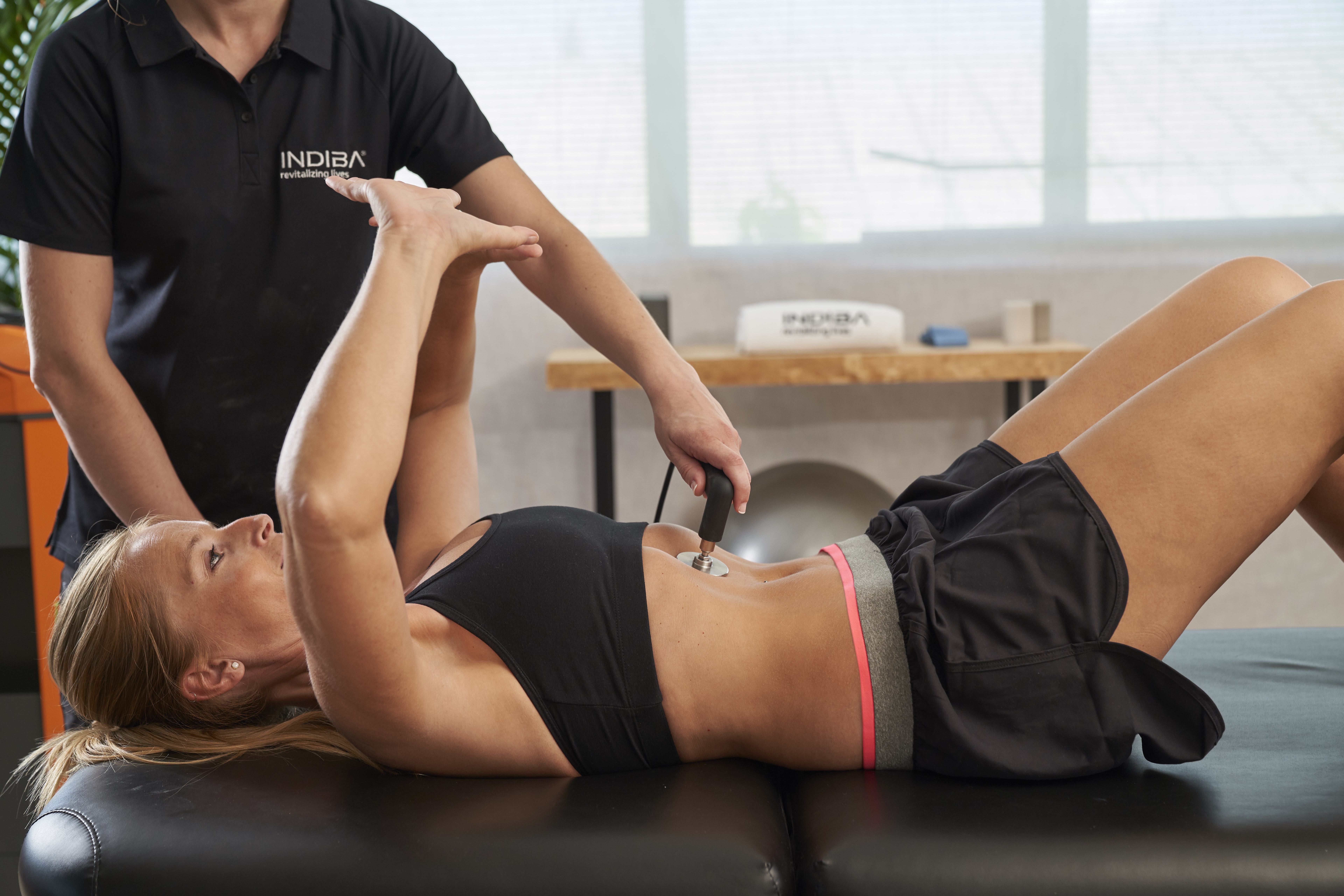
An electrode is moved across the area being treated while radiofrequency energy is delivered into the tissues.
Depending on the treatment parameters, patients may experience a comfortable warming sensation.
Treatment can also be combined with movement or hands-on techniques where appropriate.
INDIBA isn’t just for elite athletes
You certainly don’t need to be a Formula 1 driver to use INDIBA.
At The Form Practice in Hardwick, Cambridge, we use INDIBA for a range of musculoskeletal problems.
Depending on your individual assessment, it can be used as a stand-alone treatment or alongside:
- Osteopathy
- Sports therapy
- Massage
- Exercise and rehabilitation
- K-Laser therapy
The objective is to choose the treatment or combination of treatments appropriate to the individual rather than applying the same technology to every problem.
INDIBA therapy in Cambridge
If you’re recovering from a sports injury or experiencing persistent muscle, tendon or joint pain, INDIBA may be one treatment option to consider.
At The Form Practice, we can assess your symptoms and discuss whether INDIBA is appropriate for you.
Book an INDIBA appointment or contact us to find out more.